
Cookie Monster
Not even home baked goods are safe. If you want to make bread without a license, you had better not have an LLC

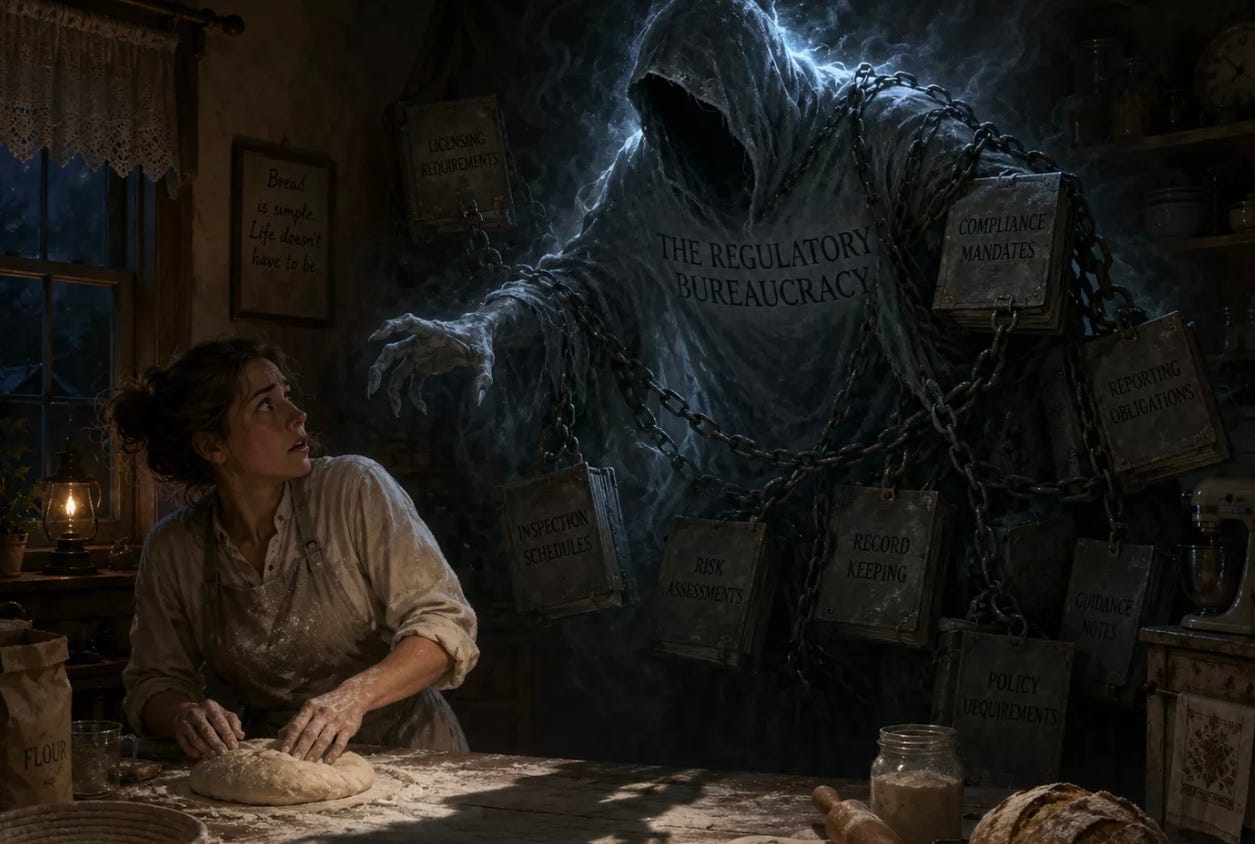
We have all known for a long time that the bureaucratic impulse to seek total control, smash free enterprise, and smother any notion of personal success and satisfaction is pretty much baked into the administrative state’s collective cake.
Turns out, it’s also baked into the cookies.
After battling the cottage food industry for decades and ultimately failing in court a decade ago to stop the direct sale of nonhazardous home-baked goods, Wisconsin’s administrative state has returned to the battlefield with yet another attempt to shut down the entrepreneurial industry.
In so doing, after losing the aforementioned court battle, they have had to concoct a creative recipe. This should have been expected because that’s the thing about bureaucracies, they will do just about anything—anything!—to get their way, often absurdly and just as often leading to burdensome and sometimes tragic consequences.
When a legislature rejects their cravings for power, agencies look for another cafeteria. When a court rules against them, they search for another menu. And when citizens finally win their rights after years of litigation and political battles, agencies often shift the fight from whether those citizens possess the right to how that right is defined.
And that is exactly what is happening once again in Wisconsin’s long-running cottage-food wars.
For years, the Wisconsin Department of Agriculture, Trade and Consumer Protection (DATCP) aggressively defended a regulatory regime that prohibited ordinary Wisconsinites from selling their homemade baked goods unless they complied with commercial licensing requirements and operated from licensed commercial kitchens.
In 2017, home bakers got those restrictions knocked down in court. Lafayette County circuit judge Duane Jorgenson ruled that DATCP could not prohibit the direct sale of homemade, shelf-stable baked goods, and subsequent orders reaffirmed and clarified that decision. The litigation became one of Wisconsin’s most important economic-liberty cases, establishing that citizens could earn an honest living selling nonhazardous baked goods from their own kitchens.
That should have been the end of the story. But now, nearly a decade later, the state has attempted to reshape that triumph into a pyrrhic victory by manufacturing a distinction that the original court rulings never considered important.
And here’s where DATCP got creative: The latest dispute centers on limited liability companies, or LLCs. According to Christopher Ingraham of the Institute for Justice (IJ), which has intervened on behalf of the home bakers, a DATCP regulatory specialist earlier this year informed a Wisconsin resident that the agency’s legal team had concluded that the court rulings (known as the Kivirist exemption after one of the plaintiffs) applied only to individuals and not to LLCs.
“On January 29, 2026, regulatory specialist Daniel Wargolet wrote in an e-mail to a Wisconsinite that DATCP’s ‘legal team... confirm[ed] that the [Kivirist] exemption applies to individuals and not corporations, including an LLC,” Suranjan Sen, an attorney for IJ, wrote in a May 27 letter to Gabe Johnson-Karp, a Wisconsin assistant attorney general. “That means to sell the baked goods out of your home kitchen you could not do it under your LLC but as an individual and take on any risk associated with selling the product individually.”
What’s more, Sen continued, Wargolet sent a follow-up email stating that the apparently new determination was based on the 2017 court decision that allowed the sale of home-baked goods in the first place.
However, as Sen explained in his letter, the new interpretation wasn’t even close to the 2017 decision. …
Read more at the MacIver Institute …